
Let’s be honest. Most side hustle advice is just trading your time for money with extra steps. Take on freelance clients! Open an Etsy shop! Offer consulting! (I’ve done all of those, and I love them. But every one of them stops paying when I stop working.)
If you want an income stream that keeps going while you’re off doing literally anything else, real estate is the holy grail. I spent years in real estate before I became a full-time blogger, and I’ve seen it build real wealth for regular people again and again!
The catch? Buying a whole separate investment property is about as financially comfortable as a root canal. For most of us, that’s a no.
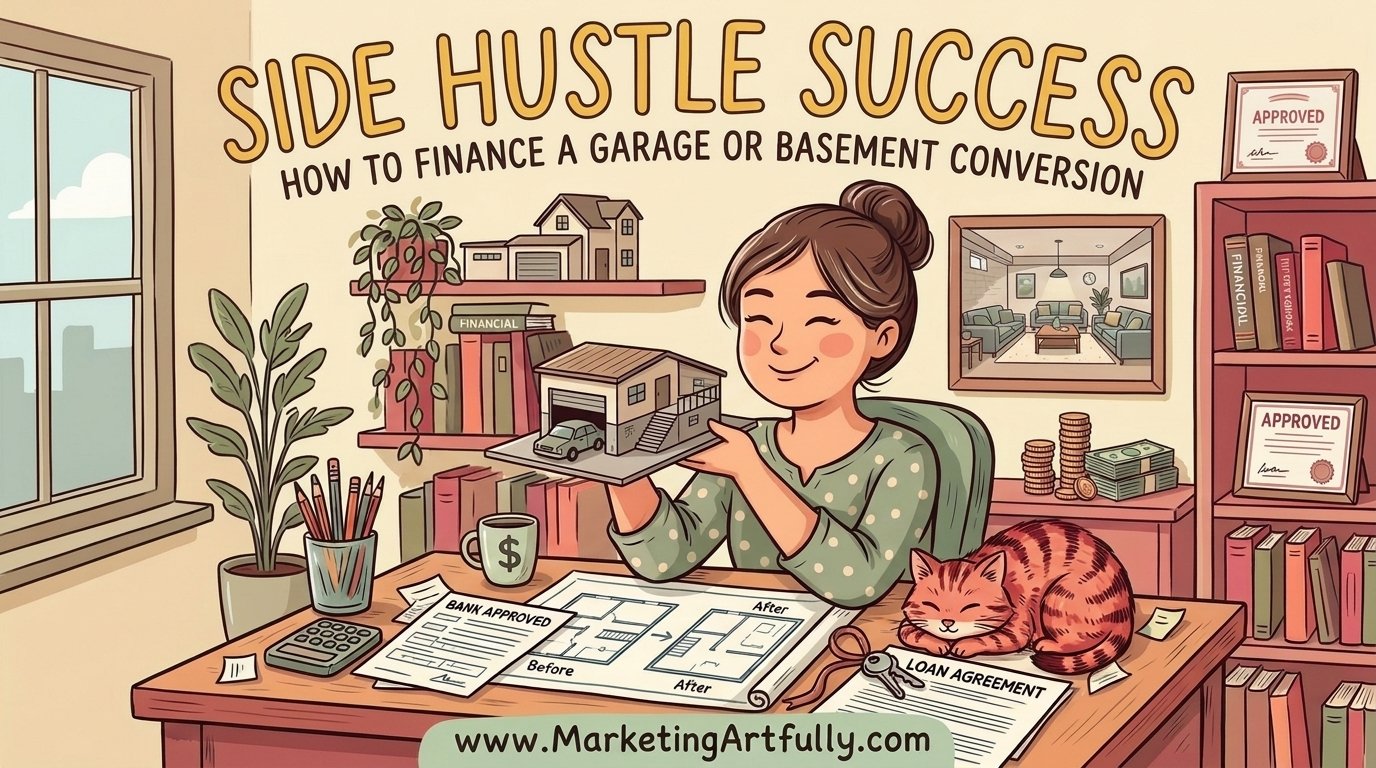
But here’s the good news... the easiest way into the rental market might be right under your feet or parked in your driveway. Turning an unused basement or garage into an Accessory Dwelling Unit (ADU) lets you “house hack” your way in.
A garage or basement conversion takes a BIG lift up front. But if you run it like a mini-business and finance it the smart way, it can turn into a profitable, permanent side hustle that pays you every single month.
So let’s talk about how to actually pay for it!
Pricing Out the Build
First things first... you need to know EXACTLY how much money it takes to bring that space up to code. (I’m not talking about a ballpark figure you made up in the shower!)
A real conversion means building a self-contained living space. You aren’t just tossing down a cute rug and calling it a day! You’re adding plumbing for a kitchenette and bathroom, upgrading your electrical panel, adding soundproofing so your tenant doesn’t hear your 6 a.m. blender, and installing proper egress windows for safety.
To avoid sticker shock (and the ugly crying that comes with it):
Get three distinct bids: Never, EVER go with the first contractor you talk to! Get three detailed estimates so you have a realistic baseline for your area. For context, a full garage-to-ADU conversion usually runs between $60,000 and $150,000. A basement apartment conversion averages $50,000 to $75,000.
Build in a contingency: Construction ALWAYS uncovers surprises, and they’re never the fun kind. Plan for an extra 15% to 20% on top of your contractor’s bid to cover surprise plumbing problems or material prices that jump overnight.
Once you have your total estimated build cost, congratulations! You have your starting funding goal.
Funding the Project
As a creative entrepreneur, you know cash flow is everything. Tying up tens of thousands of dollars of your own cash in drywall and pipes? That’s a risky move. You need those reserves for emergencies and for running your main business (because the printer WILL die the week of a launch).
So what do successful house hackers do instead? They borrow against the home to improve the home.
Home Equity Loans: This is the most straightforward route for a big renovation. You get a fixed lump sum of cash that you can hand straight to your contractors. And since the whole point is for this venture to make money, you want a fixed, predictable payment every month. No surprises! Take the time to shop around and compare current home equity loan interest rates to make sure your financing costs don't eat up your future profits.
HELOCs (Home Equity Line of Credit): Planning a slower, step-by-step build where you handle some of the demolition or finishing work yourself over a year? (Look at you, DIY queen!) A line of credit lets you draw money only as you need it instead of taking it all at once.
The Break-Even Calculation
Okay, time for my favorite part... the math. (Stay with me! I promise it’s painless.)
To find out whether your garage or basement conversion makes financial sense, you need to run a break-even calculation based on the money coming in.
Please do NOT guess what your space will rent for. Hop on local rental sites and see what comparable studio apartments or basement suites in your exact zip code are renting for right now. Pick a conservative estimate of that monthly rent, then subtract your new operating expenses.
Your monthly expenses will include:
- Your new home equity loan payment
- Higher property taxes (improving your home raises its taxable value)
- A slight bump in your homeowner’s insurance premium
- A small buffer for maintenance and utilities
The Formula: Projected Rent - (Loan Payment + Taxes + Insurance) = Monthly Cash Flow
If the math shows you breaking even, or pocketing a few hundred dollars a month right out of the gate, you’ve got a solid mini-business on your hands! And over time, as rents go up and your loan balance goes down, that profit margin only gets wider. Chef’s kiss.
Navigating the Red Tape
I know. It’s SO tempting to hire a handyman, skip the permit office, and slide a tenant into a “bootleg” apartment to save a few bucks.
Do not do this. I’m serious!
An unpermitted space is a massive financial liability. If a tenant gets hurt, or a kitchen fire starts in an unpermitted unit, your homeowner’s insurance can flat-out deny your claim and leave you personally bankrupt. And when you eventually sell your house, an unpermitted conversion usually won’t count toward your home’s official living square footage. (Ask me how many sellers I watched learn THAT one the hard way.) Your local zoning board can even make you rip the whole thing out.
Protect your investment. Pull the right permits, work with licensed contractors, and get that final certificate of occupancy.
Building Equity, One Room at a Time
A finished rental unit gives you a double win. You build permanent equity in your property AND you get a monthly income stream that keeps paying long after the sawdust settles.
Getting there takes a serious upfront effort. You’ll be managing contractors, working through local zoning rules, and lining up the right financing. But once the dust clears and your first tenant moves in, the day-to-day management is pretty low-key.
So if you’ve been eyeing that cluttered garage or that dusty basement and wondering whether it could earn its keep, a smart garage or basement conversion might be the most rewarding side hustle you ever finance. Unlike a freelance gig that stops paying the second you step away from your desk, this one keeps working for you around the clock!